
There is a question in the first chapter of my book, Beyond Bedside Manner, that I have been asking practice leaders for years.
What business are you in?
Most physicians answer with a procedure. LASIK. Cosmetic Dentistry. Facial Procedures. A few answer with an outcome. But very few answer with what their patients are actually buying. And that gap…between what you think you sell and what patients experience, is where most practices leave their growth potential on the table.
A bag of lettuce from Salinas, California helps explain why.
The Reality: You Are Already on the Value Chain. The Question Is Where.
In the 1920s, Bruce Church was a lettuce farmer in California’s Salinas Valley, the self-described “Salad Bowl of the World.” He grew lettuce. Shipped it in ice-packed rail cars across the country. Sold a commodity.
Decades later, the company he founded, Fresh Express, asked a different question. What if we washed it, cut it, and put it in a bag?
In 1989, they launched the first nationally distributed ready-to-eat bagged salad. Same lettuce. New value. They moved from growing a commodity to delivering a packaged good, and then layered a service on top by doing the prep work for you. The result was a category that now generates over $250 million in sales every month in the U.S. alone. Fresh Express was eventually acquired by Chiquita for $855 million.
One question. Enormous value created.
Joe Pine and Jim Gilmore mapped this out in what they called the Progression of Economic Value. It moves through five stages:
- Commodity – Raw materials. Lettuce in a field.
- Good – A packaged product. A head of lettuce at the grocery store.
- Service – Something done for the customer. Washed, cut, bagged salad.
- Experience – An emotionally engaging interaction. Think of a great restaurant meal where the food is almost beside the point. In the case of salad, think of getting to spend more time enjoying dinner and less time preparing it!
- Transformation – A meaningful, lasting change in how someone lives, feels, or sees themselves.
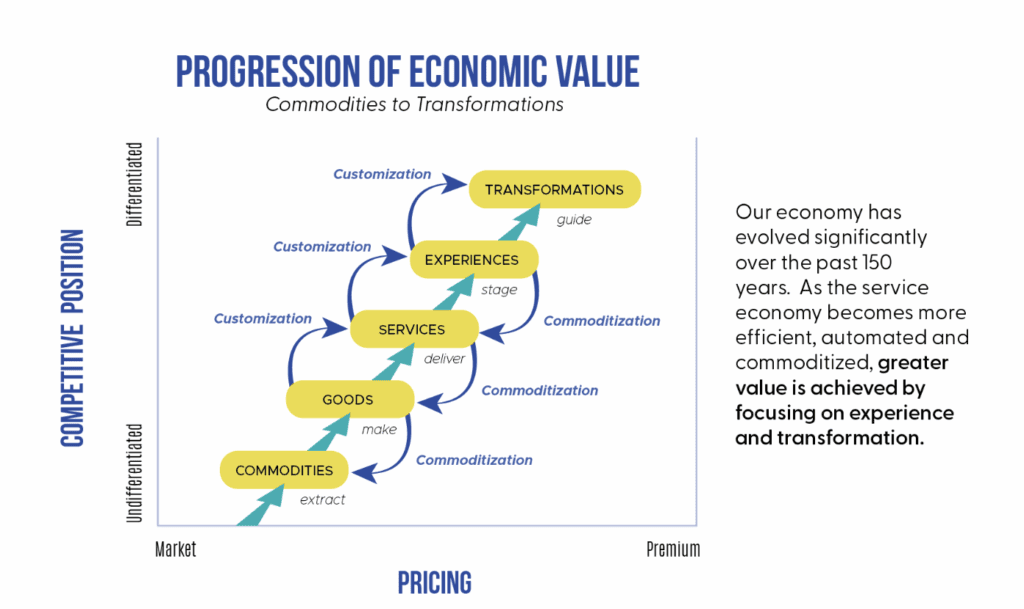
Fresh Express climbed from commodity to service and positively influenced the dinner-making experience. That was enough to build a billion-dollar business.
But here is where medicine is different.
The Shift: Elective Medicine Was Always Meant to Reach the Top of the Chain
A salad cannot transform your life. A medical procedure can.
Elective medicine sits at the top of this model by definition. The patient who finally addresses the feature they have been self-conscious about for twenty years is not buying a service.
They are buying permission to feel differently about themselves. They are making an identity decision, investing in how they show up at work, in relationships, in the mirror every morning. The clinical outcome is expected. What they are really paying for is the change in how they move through the world afterward.
That is transformation. And it is available to every elective practice that is intentional about delivering it.
But here is the problem. Most practices are operating and being perceived at the Service level. They deliver a technically excellent procedure. They charge for the clinical work. And they leave the transformational value largely unclaimed, because they have not designed the experience that makes patients feel it before, during, and after their visit.
This is not a clinical failure. It is an experience failure. And it is entirely fixable.
This is precisely the question I ask in Insight 1 of Beyond Bedside Manner: What business are you in?
If your answer is still a procedure, you are pricing and positioning yourself as a service provider. Your patients may appreciate the outcome. But they are not experiencing the transformation you are capable of delivering and that distinction shows up in your referrals, your reviews, and your revenue.
The practices that move up the chain do so deliberately. They design the patient journey from first contact to follow-up. They train their teams around a shared language for what great experience actually looks like. They treat the experience as a system, not a personality trait. And when they do, something shifts in how patients talk about them, in how referrals happen, and in what patients are willing to invest.
PX90 is built to help practices make that shift. If you are curious where your practice sits on this chain today, a PX FitCheck is a good place to start.
And if you want to explore all 57 insights from Beyond Bedside Manner, they are waiting for you.
Learn more at pxmovement.com