
This morning I opened my front door and found two Amazon packages waiting on the mat, one boxed, one padded envelope, both stamped with the blue Prime logo. Ordinary. Unremarkable. I almost stepped over them without a second thought, until I stopped and asked myself: when exactly did this become normal?
Twenty years ago, getting something you needed meant getting in the car, driving to a store, finding parking, walking the aisles, standing in line, and driving home. That was not an inconvenience. That was simply how you bought things. Nobody complained about it, because there was nothing to compare it to.
Now the idea of doing all that for a phone charger or a birthday gift feels almost absurd. We tap a button, and it appears at our door, sometimes within hours.
That shift did not happen because we became lazier. It happened because someone built a better way, and once we experienced it, we could not unsee it as better. Our expectations reset permanently, and they have never gone back.
The Reality
Amazon did not just change how we shop. It changed what we consider acceptable friction everywhere. Once you have used mobile check deposit, standing in line at a bank teller feels backward. Once you have used a rideshare app, waiting on a curb for a dispatched cab feels like a relic. Once you have streamed a movie instantly, driving to a video store, if you can even remember what that was, sounds like a joke.
Frictionless does not mean no effort at all. It means every unnecessary step has been engineered out. The steps that remain are the ones that matter: deciding what you want, and receiving it. Everything else, the searching, the traveling, the waiting in line, the fumbling for payment, has been quietly designed away by people who studied the entire journey and removed what did not serve the customer.
Once you have used a tap-to-pay card, digging for exact change feels like a throwback. Once you have used a food delivery app, calling a restaurant and reading your address out loud feels unnecessarily hard. None of these examples are dramatic on their own. That is precisely the point. Frictionless experiences do not announce themselves. They simply become the new baseline, and everything that fails to meet that baseline starts to feel like a small tax on our time and patience.
Most practice leaders assume this is a retail phenomenon that does not touch healthcare, especially not their specialty. That is the blind spot. Patients do not compartmentalize their expectations by industry. They carry the same standard of ease from Amazon to their bank to their doctor’s office, whether or not that comparison feels fair to those of us on the receiving end.
This matters more than a passing observation about consumer habits. There is a well established progression of economic value, described by Pine and Gilmore in The Experience Economy: commodities, goods, services, experiences, and transformations. Each stage represents a higher order of value, and each maps to how it treats a customer’s time. Services save time. Experiences make time well spent. Transformations, which fundamentally change the person receiving them, make time well invested.
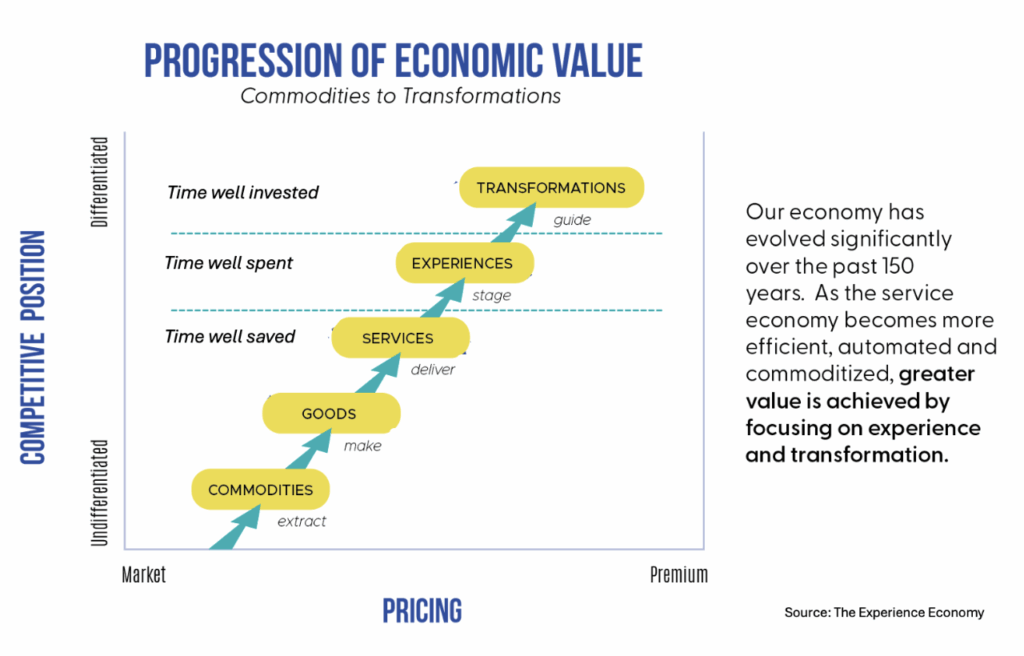
Frictionless buying is what happens when goods and services become commoditized enough that speed and ease turn into the entire differentiator. And that has a second order effect worth paying attention to. When people save time and mental energy on ordinary purchases, they have more of both left over to spend on experiences and transformations, the things that actually change how they live.
The Shift
Here is where it gets interesting for those of us in medicine, especially elective and self-pay care. A medical visit is not a commodity purchase. It sits, by nature, at the top of that value progression: a patient moves from limitation to capability, from dependence to independence. That is a transformation, the highest order of value there is, and it should command the highest expectations for how it is delivered, not the lowest.
Yet many practices still deliver that transformation wrapped in commodity-level friction: confusing phone trees, redundant paperwork, unclear pricing, long waits, disjointed communication between departments. The clinical outcome might be excellent. The experience of getting there often is not.
This is the trap. Practices assume that because their clinical work is superior, patients will tolerate the friction that surrounds it. For a long time, that was true, because patients had nothing else to measure it against. That protection is gone. Patients now evaluate the ease of every interaction against the best experience they had that week, whether it was ordering dinner or requesting a rideshare, not against other doctors down the street.
This is not a call to lower clinical standards in favor of convenience. It is a recognition that clinical excellence and experiential ease are no longer separate categories in the patient’s mind. They blend into a single impression of whether this practice, this team, respects the patient’s time and attention. A brilliant surgical outcome preceded by three confusing phone calls and an hour in the waiting room does not read to the patient as brilliant. It reads as a mixed experience, and mixed experiences do not generate referrals the way exceptional ones do.
At Laser Eye Center of Silicon Valley, frictionless is a guiding principle, not a slogan. It shapes how we think about the entire arc of the patient journey: learning about modern vision correction, going through testing and clinical evaluation, and undergoing the procedure itself. At each stage we ask a simple question: what step here exists for our convenience rather than the patient’s? Removing those steps takes deliberate structure. It is not a personality trait that some staff happen to have and others don’t. It is a system, built and maintained on purpose.
That is the real shift required of practice leaders. Patient experience is not about being nicer or smiling more at the front desk. It is about examining every touchpoint through the patient’s eyes and having the discipline to redesign what does not serve them. Practices that treat this as a system, with shared language and clear ownership across the team, produce consistent results. Practices that leave it to individual staff discretion produce inconsistent ones, no matter how talented those individuals are.
And this is not limited to elective, self-pay specialties. Whether your practice runs mostly on insurance reimbursement or out-of-pocket payment, the expectation bar has moved for every patient who also happens to be an Amazon customer, a rideshare user, a mobile banking customer, which is to say, nearly everyone. Reimbursed practices do not get a pass on this simply because the payment mechanism is different. A patient’s tolerance for friction is set by their whole life, not by their insurance card.
The packages on my porch this morning were a small reminder of something big: the bar for effortless has been permanently raised, and it applies to us too. Practices that understand this, and build the structure to deliver on it, will attract more patients, retain them longer, and generate the kind of word of mouth that no marketing budget can buy.
If you are curious where your practice stands, a PX FitCheck is a good place to start. Learn how PX90 helps teams turn intention into consistent, frictionless experience at https://pxmovement.com.