

Even if football isn’t your thing, you need to hear this story.
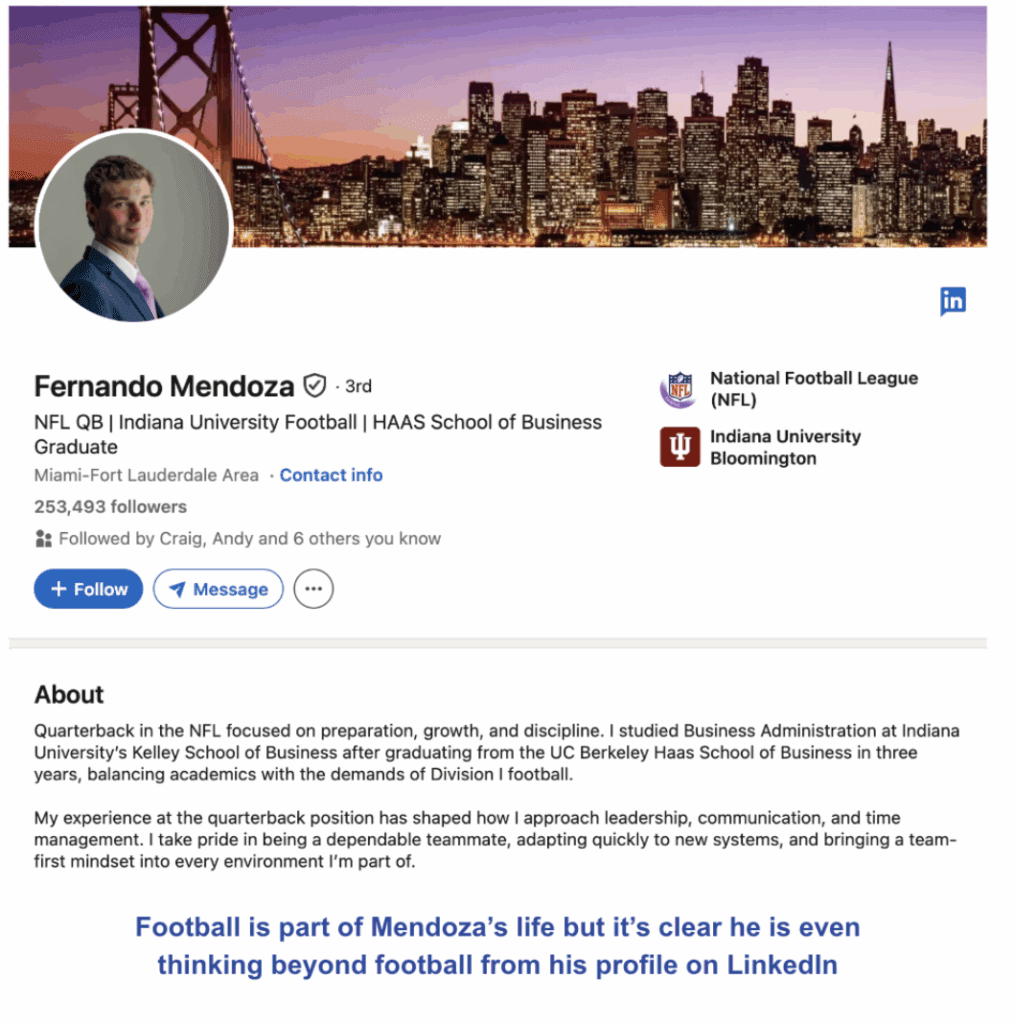
Fernando Mendoza was ranked 2,149th coming out of high school. Not a single scholarship offer. He eventually walked on at Cal, worked his way up from fourth string, and earned the starting job. For his senior year, he transferred to Indiana, where his younger brother was already enrolled as a quarterback.
What followed was one of the most remarkable seasons in college football history: undefeated, Heisman Trophy winner, national champion. That final game was held in Miami, the city where he grew up dreaming of playing for the Hurricanes who once turned him away.
Last week, the Las Vegas Raiders made him the number one overall pick in the NFL Draft.
But it’s not the trophy or the title that I keep coming back to. It’s what happened during a facility tour at Raiders headquarters in Henderson, Nevada.
Paying Attention Is a Strategy
Before the Raiders made their pick official, they brought Mendoza in for a pre-draft visit, essentially a job interview. GM John Spytek told the New York Times/The Athletic what sealed it for him. “I’m a big believer in human interactions,” Spytek said, reflecting on what happened that sealed the deal.
During the tour, Mendoza and the Raiders’ brass walked through the scouting wing past a wall lined with posters of Raiders Hall of Famers. Most people in that situation would keep moving. Mendoza stopped. He looked. He asked questions.
Spytek described it this way: he wasn’t doing it because he should, he was genuinely interested.
That moment of authentic curiosity told Spytek everything he needed to know. Mendoza wasn’t performing interest. He was paying attention.
One act. One unscripted moment. It tipped the scales on a decision that will define a franchise.
Read the full story here: How Fernando Mendoza won over John Spytek
The Reality: What This Has to Do With Your Practice
I’ll be honest: when I read that story, I didn’t think about football. I thought about every practice I’ve walked into over the past two decades, as an operator, a consultant, and a coach.
Because the same skill that made Mendoza the number one pick is the same skill that separates thriving practices from stagnating ones. Not clinical excellence. Not marketing spend. Not the latest technology.
Paying attention.
Specifically: paying attention to what your patients are experiencing.
What do they see when they walk in? What do they hear at the front desk? What does the handoff from tech to doctor feel like? What happens in the silence between steps in the visit? Is your team present, or are they executing a checklist?
Most practices aren’t ignoring these things out of laziness. They’re ignoring them because no one ever built a system for noticing.
That’s the gap. And it’s a big one.
The Shift: From Intention to Habit
Here’s what I’ve learned from working inside practices and coaching teams through PX90: good intentions don’t create consistent experiences. Systems do.
Mendoza didn’t accidentally stop at that wall of fame. His curiosity is a trained disposition. It’s part of who he is and how he prepares. And it showed up naturally, without prompting, in a high-stakes moment.
That’s what PX90 is designed to do for your team. Not to make people “nicer.” Not to train empathy as a soft skill. But to build shared habits of attention, so that every person on your team is noticing what patients notice, responding to what patients need, and creating experiences that feel intentional rather than incidental.
When an entire team is paying attention the way Mendoza paid attention in that hallway, something shifts. Patients feel it. And they tell people.
That’s how practices grow.
| If you’re curious whether your practice has those systems in place, a PX FitCheck is a good place to start. Learn more at pxmovement.com |