
You’re committed to delivering great care.
You already believe patient experience matters. You have likely invested in it, talked about it with your team, and made meaningful improvements along the way.
And now, AI is everywhere.
New tools. New promises. New opportunities to streamline your practice.
But if you are paying attention, you are probably asking a deeper question.
What happens to the human side of healthcare as technology accelerates?
The Paradox: More Technology, Higher Expectations
We are living in a time when patients arrive more informed than ever.
They have researched their symptoms. They have read reviews. Some have even used AI tools to understand their condition before they step into your office.
On the surface, that sounds like progress.
And it is.
But here is the paradox.
The more access patients have to information, automation, and AI, the more they expect from human interaction.
As one practice leader put it perfectly:
“So many things in life are now automated, people want and expect their human interaction to be top notch.”
This is the shift.
Technology raises the bar for humanity.
Not the other way around.
AI in Healthcare Patient Experience: The Opportunity and the Risk
There is no question that AI in healthcare patient experience is evolving quickly.
We are already seeing tools that:
- Handle intake forms
- Answer common questions
- Follow up with patients after visits
These tools can improve efficiency. They can reduce friction. They can free up your team’s time.
And that is valuable.
But there is a line.
AI can support communication.
It cannot replace connection, but it can deliver information.
It cannot create trust, but it can automate steps.
It cannot replicate how a patient feels when they are truly seen and understood.
That is where many practices risk losing their advantage.
The Danger of Thinking AI Is the Answer
If your inbox looks anything like most medical practice leaders right now, you are being pitched constantly with new tools promising to increase revenue, improve efficiency, and transform your practice overnight.
It is tempting, because they offer what feels like a shortcut.
But AI is not a panacea. If anything, it amplifies what is already there.
If your patient experience is strong, AI can enhance it. If it is inconsistent, AI will expose it.
The real risk is not adopting AI. It is relying on it to replace what only your team can deliver.
What AI Will Never Replace
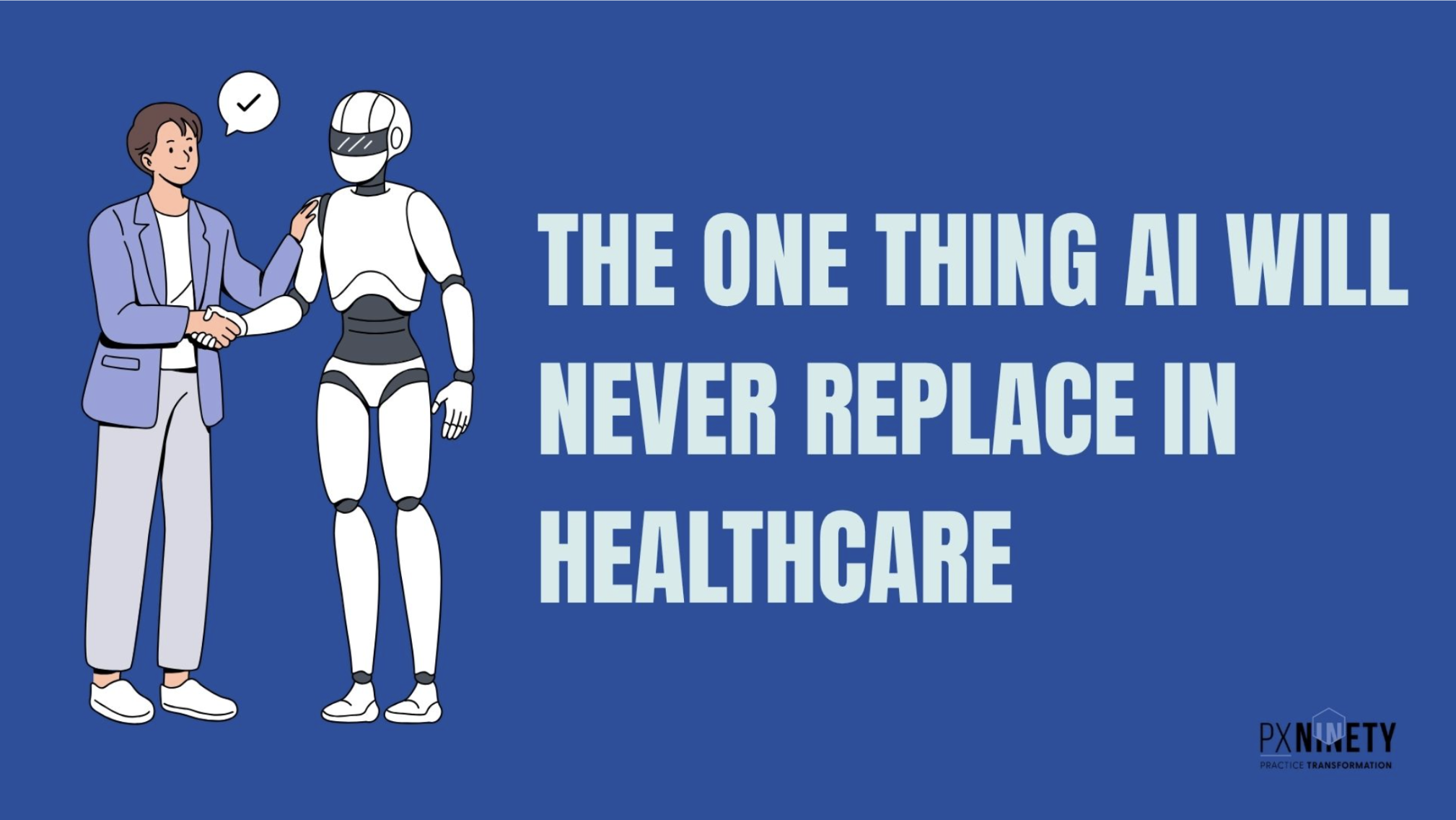
There is one thing AI will never replace in healthcare: human connection.
It’s the moment a patient feels understood, the tone of voice that communicates empathy, the confidence they gain when they trust you, and the subtle signals that say, “You matter here.”
That is what patients remember. Not the efficiency of your system or how quickly a chatbot responded, but how they felt in your care.
As healthcare becomes more automated, human connection becomes the true differentiator.
The Doctor-Patient Relationship Still Matters Most
The doctor patient relationship has always been the foundation of healthcare. AI does not change that. If anything, it makes it more important.
As more of the experience becomes automated, the human moments stand out even more. Patients are not just looking for answers. They are looking for reassurance, confidence, and a sense that they are in the right hands.
In the end, they are not just evaluating outcomes. They are evaluating how you made them feel along the way.
That is where your practice wins or loses.
Technology vs Human Interaction in Healthcare
This is not about choosing between technology and human interaction. It is about using technology to support and elevate it.
The practices that succeed will not resist AI. They will adopt it thoughtfully, using it to remove friction, streamline processes, and create more space for meaningful connection.
Because that is the real goal.
Not replacing the human experience, but enhancing it.
The Competitive Advantage Has Not Changed
Despite all the technological change, the competitive advantage in healthcare remains the same.
It is not the tools you use.
It is the experience you create.
The practices that win will:
- Use AI to improve efficiency
- Train their teams to deliver exceptional human interaction
- Build systems that ensure consistency in how patients are treated
Because in the end, the differentiator is not technology.
It is how your patients feel.
Turning Intention Into Consistency
This is where most practices struggle.
You already know this matters.
You want your team to deliver a consistent, human centered experience.
But without structure, it becomes variable.
Without alignment, it becomes dependent on the individual.
Without a system, it becomes difficult to sustain.
That is exactly where PX Movement comes in.
PX Ninety gives you a clear, step by step way to ensure that the human side of your practice is not left to chance.
It aligns your team.
It builds consistency.
It turns patient experience into something you design intentionally.
Not something you hope happens.
What This Looks Like in Practice
Imagine a patient who has already completed their forms through AI before they arrive.
Efficient. Seamless. Easy.
But when they walk in, they are greeted by name.
They feel welcomed.
They feel seen.
During their visit, your team is present. Engaged. Focused on them, not just the process.
After the visit, follow up is thoughtful and reinforces the relationship.
That is the balance.
Technology handles the tasks.
Your team delivers the experience.
That is how you use AI without losing patient experience in a medical practice.
Your Next Step
You already know patient experience matters.
The question is whether your current approach is strong enough to stand out in a world where technology is everywhere.
You already know patient experience matters, now find out how yours is performing with a 15-minute PX FitCheck.